.webp)








Satisfactory is often described as a relaxing factory-building game about automation, exploration, and optimization on an alien planet. In its early hours, the experience feels clean, logical, and deeply satisfying. Conveyors flow neatly, machines hum efficiently, and progress feels constant. However, as factories expand, Satisfactory reveals its defining issue: exponential scaling. This scaling transforms simple production lines into sprawling industrial systems that strain planning ability, spatial reasoning, and mental endurance. This article examines how exponential growth becomes both the game’s greatest strength and its most exhausting challenge.
1. The Comfort of Linear Beginnings
The opening hours of Satisfactory are deliberately gentle. Players start with basic miners, smelters, and constructors. Production chains are short and easy to visualize.
Each new unlock feels manageable. Inputs and outputs are clear, and mistakes are easy to fix. The factory grows horizontally, not vertically, allowing players to learn core mechanics without pressure.
This sense of clarity is crucial because it builds player confidence before the game introduces its true complexity.
2. The Moment Scaling Breaks Simplicity
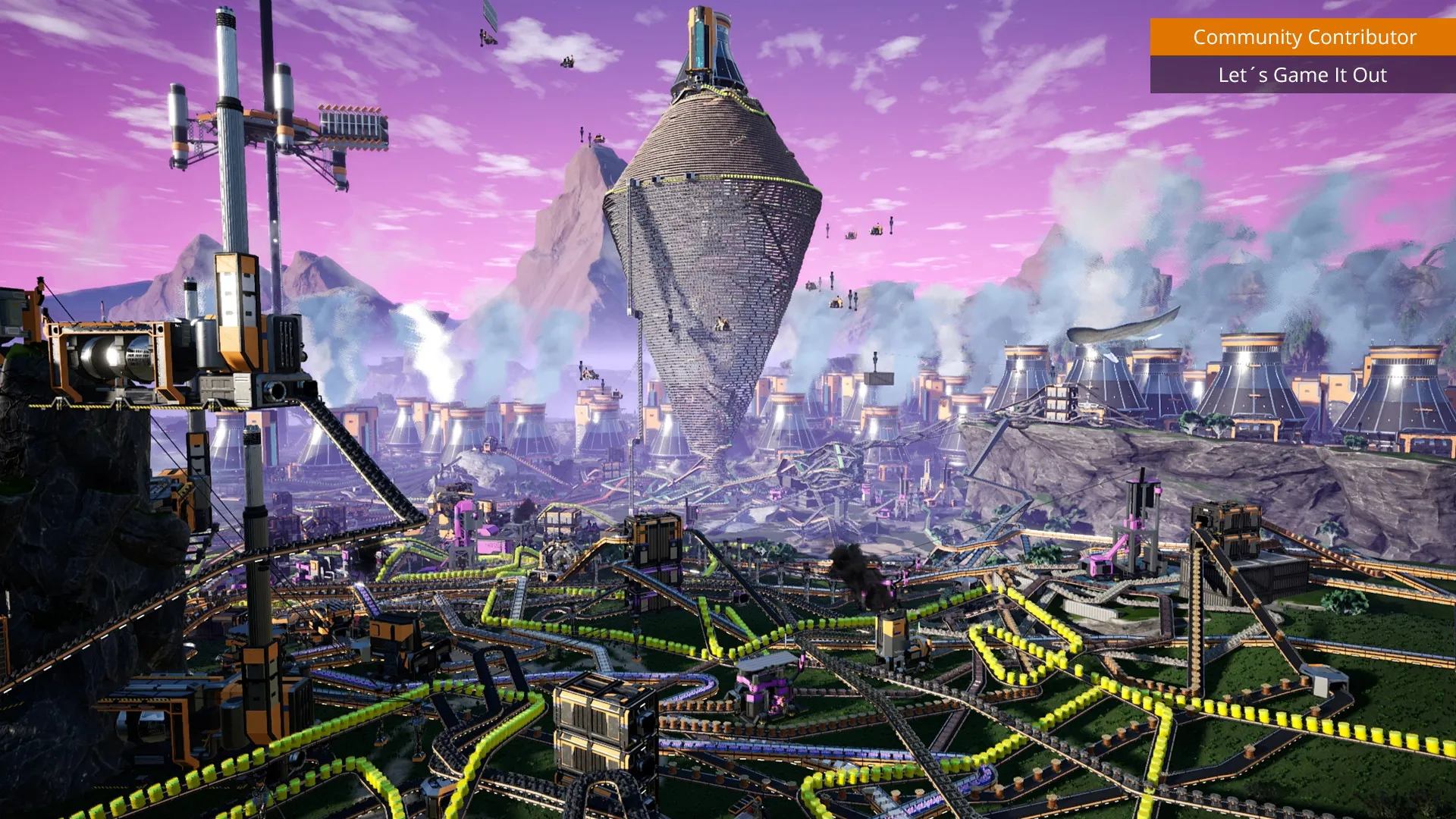
The transition from early tiers to mid-game marks a dramatic shift. Suddenly, single products require multiple intermediate components, each with its own production chain.
One simple item now depends on dozens of machines spread across large distances. Bottlenecks appear, power consumption spikes, and logistics become fragile.
The illusion of control fades
Players still understand individual machines, but no longer grasp the factory as a whole.
This is where exponential scaling begins to dominate the experience.
3. Exponential Inputs and Cognitive Overload
Satisfactory’s recipes scale multiplicatively, not additively. Adding one new product often requires expanding several existing production lines simultaneously.
This creates cognitive overload. Players must track dozens of resource flows, ratios, and dependencies while planning future expansion.
Why spreadsheets emerge
At this stage, many players turn to external tools because the human brain struggles to manage exponential relationships unaided.
The game quietly shifts from intuitive building to abstract systems management.
4. Verticality as a Response to Scale
As horizontal expansion becomes unwieldy, players turn upward. Multi-floor factories, stacked conveyors, and vertical logistics become necessary.
Vertical design solves space problems but introduces new ones. Visibility decreases, debugging becomes harder, and traversal time increases.
The cost of vertical efficiency
What saves space often sacrifices readability. Players may optimize output while losing clarity, increasing long-term maintenance difficulty.
5. Power Management and Cascading Failure
Exponential scaling does not only affect production—it devastates power systems. Each expansion increases energy demand non-linearly.
One miscalculation can overload the grid, shutting down entire factories. Restarting production requires tracing failures across dozens of machines.
Failure scales too
As factories grow, mistakes affect larger portions of the system, increasing frustration and recovery time.
6. Logistics: When Belts Are No Longer Enough
Conveyor belts work well early on, but scaling introduces long-distance transport challenges. Trains, drones, and trucks become necessary.
Each logistics layer adds complexity. Scheduling, throughput limits, and synchronization issues arise. A single delay can starve critical production.
This turns logistics into a strategic discipline rather than a convenience.
7. Redesign Pressure and Player Burnout
As factories grow organically, inefficiencies accumulate. Eventually, players face a difficult truth: incremental fixes are no longer enough.
Large-scale redesign becomes inevitable. Entire factory sections must be dismantled and rebuilt, often costing hours of work.
Psychological resistance to rebuilding
Players often delay redesign due to emotional attachment to their creations, increasing burnout when collapse becomes unavoidable.
8. Mastery Through Modular Thinking
Experienced players learn to fight exponential scaling through modular design. Instead of one massive factory, they build independent, standardized modules.
Modules isolate failure, simplify debugging, and reduce cognitive load. Expansion becomes duplication rather than reinvention.
This approach marks the transition from reactive building to intentional engineering.

9. The Skill Ceiling: Systems Thinking
High-level Satisfactory play is not about speed or aesthetics. It is about systems thinking—anticipating future needs and designing scalable solutions early.
Skilled players plan with ratios, buffer zones, and future expansion space in mind. They design factories meant to be replaced.
This mindset transforms exponential scaling from a threat into a manageable challenge.
10. Why Exponential Scaling Defines Satisfactory
Exponential scaling is not a flaw—it is Satisfactory’s identity. It creates tension, forces growth, and demands intellectual adaptation.
The game constantly asks whether players will patch problems or redesign systems. Every factory is temporary. Every solution is a prototype.
Progress as reinvention
Satisfactory teaches that true efficiency comes not from perfection, but from the willingness to rebuild better systems.
Satisfactory’s exponential factory scaling reshapes the player experience from intuitive construction to complex systems engineering. What begins as simple automation evolves into a demanding test of planning, abstraction, and mental endurance. The pressure to redesign, the risk of cascading failures, and the challenge of maintaining clarity define the game’s mid and late stages. Yet within this struggle lies Satisfactory’s brilliance. By forcing players to confront the limits of organic growth, the game rewards those who embrace modularity, foresight, and continuous reinvention. Satisfactory is not about building the perfect factory—it is about learning how to think like an engineer in an ever-expanding system.